


Axanthic Copper Axolotl
Axanthic Copper Axolotl
Couldn't load pickup availability
Description
To protect our animals and to ensure they arrive healthy, axolotls ship directly from our dedicated breeding partner using expedited overnight service.
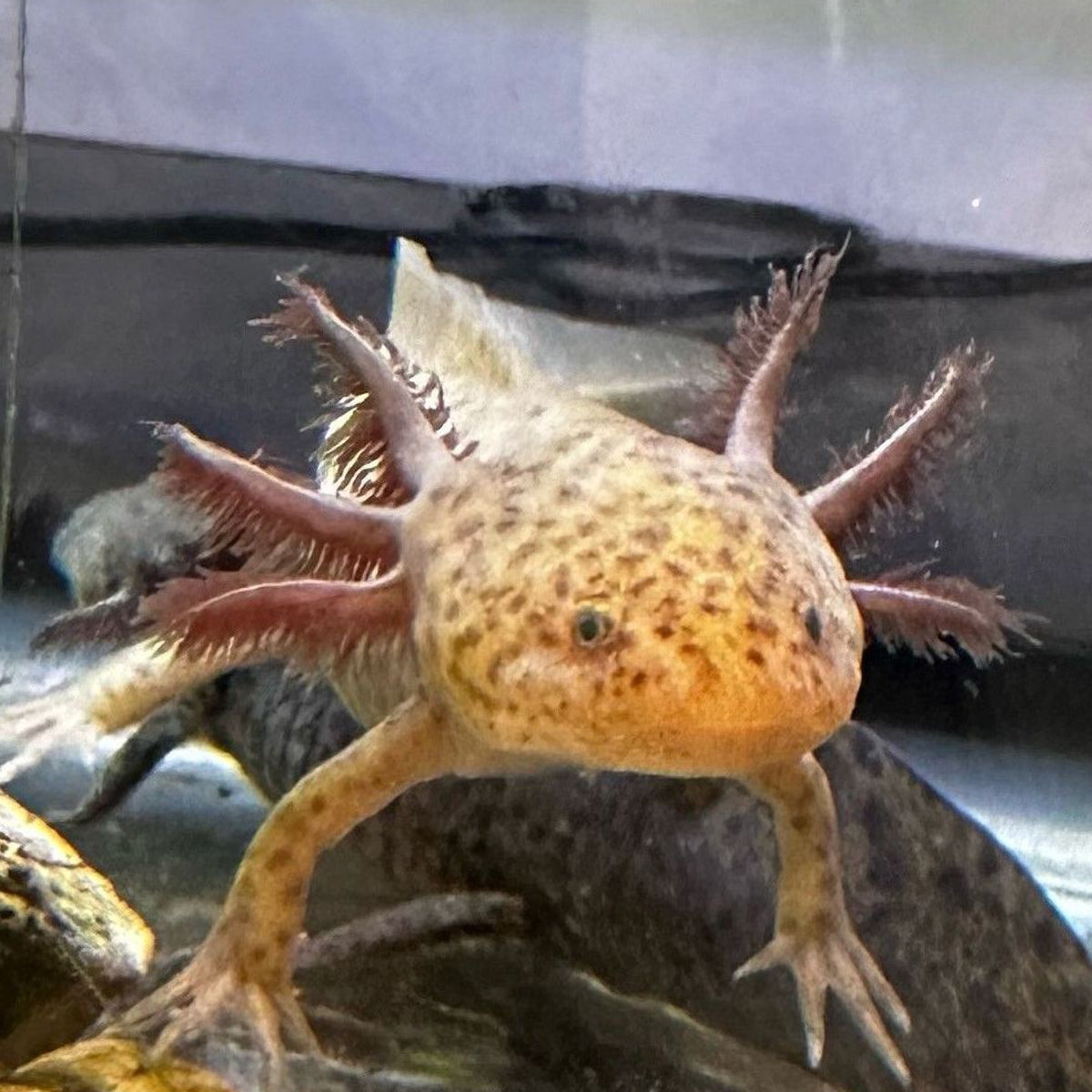
The Axanthic Copper Axolotl (Ambystoma mexicanum) combines copper genetics with the axanthic trait, which strips out yellow pigment. The result is a cool, muted copper in shades of silver, taupe, and pale gray-brown rather than the warm caramel of a standard copper.
Axanthic Coppers are uncommon and appeal to keepers who prefer a restrained, desaturated look. The absence of yellow gives them a distinctly metallic, almost pewter quality.
About This Axolotl
Copper lightens the dark pigment a wild type would carry, while axanthic removes the yellow xanthophores. Together they leave a pale, cool-toned animal with soft freckling and none of the golden warmth seen in other copper morphs.
Eyes are usually reddish, and gills tend toward a muted rose. Coloring often becomes more defined as the animal matures, with the freckling sharpening against the pale body.
Axolotls are neotenic salamanders, meaning they retain their larval features and external gills for life rather than transforming into a terrestrial adult. They remain fully aquatic from hatching onward.
Aquarium Care
Axolotls are cool-water amphibians and must be kept in a fully cycled aquarium with stable water quality. They are sensitive to ammonia and nitrite, so the aquarium should be established and tested before an axolotl is introduced.
Temperature is the single most important factor in axolotl care. They do best in cool water and become stressed once temperatures climb into the mid 70s Fahrenheit. A tank placed in a cool room is usually sufficient, although a chiller or clip-on fan may be needed in warmer climates.
Keep the current gentle. Strong flow causes stress and can fold the gill filaments back against the body. A sponge filter, or a canister outlet fitted with a spray bar, works well.
Tank Setup
Substrate choice matters more than almost anything else in the aquarium. Use a bare bottom or fine sand only. Gravel and small stones are readily swallowed during feeding and are a leading cause of impaction.
Provide caves, PVC pipe, terracotta pots, or other shaded retreats. Axolotls have no eyelids and prefer subdued lighting. Live or artificial plants and a partial cover will help them feel secure.
A 20-gallon long aquarium is the practical minimum for a single adult, with roughly 10 additional gallons for each further axolotl. Floor space matters more than depth. Darker sand and driftwood give the pale, cool coloring more contrast.
Avoid sharp decorations and any ornament with narrow openings an axolotl could become trapped in.
Diet
Axolotls are carnivores. Sinking axolotl pellets or soft carnivore pellets make an excellent staple diet, supplemented with earthworms, nightcrawlers, live blackworms, and frozen bloodworms.
Juveniles are generally fed daily, while sub-adults and adults are fed every two to three days. Offer food at the bottom of the aquarium where the axolotl naturally hunts, and remove anything uneaten to protect water quality.
Avoid feeder fish, mammalian meats, and hard-shelled foods. These can introduce disease or cause digestive problems.
Tankmates
Axolotls are best kept alone or with other axolotls of a similar size. Anything small enough to fit in the mouth will eventually be eaten, including nano fish, dwarf shrimp, and small snails.
Fish are not recommended. Many species nip at the exposed gill filaments, and most community fish require temperatures far too warm for an axolotl.
When housing more than one axolotl, keep them closely matched in size and provide separate hiding places and generous floor space. Smaller individuals may lose limbs or gills to larger tankmates.
Breeding Notes
Axolotls generally reach breeding condition between 12 and 18 months of age. The male deposits spermatophores that the female collects, after which she lays several hundred eggs on plants, decor, and aquarium glass.
Eggs hatch in roughly two to three weeks depending on temperature. Larvae need live foods such as baby brine shrimp and microworms from the moment they begin feeding.
Axanthic Copper depends on a combination of recessive traits, so offspring will not reliably match the parents. Larvae are cannibalistic and must be sorted by size, and a single clutch can produce far more young than most keepers are able to house.
Recommended Water Parameters
Temperature: 60° to 68° F (optimal 62° to 64° F)
pH: 6.5 to 8.0 (optimal 7.4 to 7.6)
KH: 3 to 8 dKH
GH: 7 to 14 dGH
Minimum tank size: 20-gallon long for a single adult, with approximately 10 additional gallons per further axolotl
Adult size: Approximately 9 to 12 inches
Typical purchase size: Varies by option selected, from 3 to 5 inches for juveniles to 8 inches or more for adults
Origin: Captive-bred; the wild species is native to Lake Xochimilco, Mexico
What We Like About This Axolotl
• Cool, desaturated copper with a pewter quality
• Yellow pigment removed for a distinctly muted look
• Soft freckling that sharpens with maturity
• Reddish eyes and muted rose gills
• Uncommon and hard to find in the hobby
• Hardy and straightforward to keep in cool water
Important Notes
Tone ranges from pale silver-taupe to a deeper gray-brown between individuals, and freckling density varies. Coloring normally becomes more defined as the animal matures.
Axolotls are a cool-water species and should never be kept in a heated aquarium. Sustained temperatures in the mid 70s Fahrenheit and above will cause stress and can lead to illness.
Fine sand or a bare bottom is strongly recommended, as gravel and small stones are a common cause of impaction. Axolotl skin is delicate and the skeleton is largely cartilaginous, so handling should be kept to a minimum and never done with dry hands.
Axolotl ownership and sale are restricted in certain U.S. states and jurisdictions. Customers are responsible for verifying that axolotls are legal to own and receive in their state and local area before ordering.
Shrimpy Business cannot ship to jurisdictions where axolotls are prohibited or require permits that have not been obtained. We are not responsible for animals refused, confiscated, or restricted due to local laws or regulations.
Select your preferred size above, from juvenile through adult male or female. Color, size, and markings vary between individual animals, and the axolotl you receive will not be identical to the photographs.