

From small but vibrant cherry barbs to fun and feisty tiger barbs, barbs are active, colorful fish that often work well in community aquariums. Not only do barbs come in a wide range of hues and patterns, but they’re relatively simple to care for. You can even learn how to breed barb fish without any previous experience with breeding fish.
In this guide, we’ll explore the basics of breeding barbs. You’ll learn how to set up a breeding tank, how to identify spawning behavior, and what to expect after spawning. Let’s get started!
Introduction to Barb Fish
Members of the minnow family Cyprinidae, Barbs are small schooling fish. There are hundreds of different species, but some of the most popular barbs in the aquarium hobby include:
-
Cherry Barb (Puntius titteya)
-
Tiger Barb (Puntigrus tetrazona)
-
Rosy Barb (Pethia conchonius)
-
Tinfoil Barb (Barbonymus schwanenfeldii)
-
Clown Barb (Barbones everetti)
-
Denison Barb (Sahyadria denisonii)
-
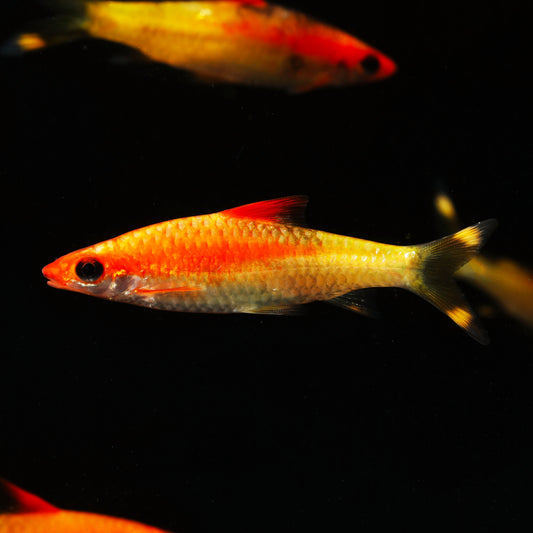
Gold Barb (Barbodes semifasciolatus)

$19.95
Unit price
per
$119.95
Unit price
per
The most important thing to remember about stocking barbs in your aquarium is that they’re best kept in groups of at least six. When kept alone or in groups too small, barbs can become stressed. Some species are also prone to fin nipping, but keeping them in large groups may help to reduce this behavior.
Understanding Barb Fish Breeding Behavior
All barbs are egg layers, and they don’t exhibit any parental care. These fish generally scatter their eggs among plants and substrate in the tank, and they’ll often eat their own eggs. If you hope to raise the fry, you’ll need a plan to separate the adults from the eggs after spawning.
The good news is that barbs are fairly easy to breed in captivity, as long as the conditions are right. Some species, like the cherry barb, have even been known to spawn with little to no intervention. Many aquarium hobbyists have had success breeding tiger barbs and gold barbs as well.
To improve your chances of successfully breeding barbs, it’s wise to establish a strong breeding group. Aim for a ratio of 1 male for every 2-3 females. This helps mitigate male-on-male aggression and reduces stress on the females. Unfortunately, it can be difficult to tell the difference between the sexes with barbs before they’ve reached sexual maturity.
Male barbs tend to be slightly smaller and slimmer than females, but they’re also generally more brightly colored. Females may be noticeably larger and rounder, especially when their bellies are full of eggs. In some species, like cherry barbs, females will develop a dark lateral line bar when they’re ready for breeding.

Setting Up a Breeding Tank for Barb Fish
When it comes to breeding barb fish, there are two options if you hope to raise the fry to maturity. One option is to set up a separate breeding tank and remove the adults after spawning. The second is to make arrangements in your Barb tank to shield the eggs and young fry from the hungry adults.
Here are some basic tips for setting up a breeding tank for barb fish:
-
Start with a 10-gallon tank (or larger). A 10-gallon tank can accommodate a small group, but larger schools will improve your chances of successful breeding, so consider a 20-gallon tank.
-
Line the bottom of the tank with mesh, spawning mops, or fine-leaved plants like Java moss for your barbs to scatter their eggs over.
-
Keep the aquarium warm (between 78° and 82°F) and aim for a pH level between 6.0 and 6.8, using a sponge filter to provide gentle filtration.
-
Avoid harsh lighting and make sure there are plenty of hiding places in the tank for your female barbs to rest when the attention of the males becomes overwhelming.
Once your breeding tank is set up, the next step is to condition your fish for breeding. This involves feeding them a healthy, varied diet to encourage egg production and overall health. Plan to maintain this diet for about 10-14 days before placing the adults in the breeding tank (or attempting to trigger spawning in your main tank).
How to Trigger Spawning
If you’re breeding barbs in a regular aquarium, they may spawn on their own if the conditions are right and they’re sexually mature. When using a separate breeding tank, it’s often recommended to condition the male and female fish separately. This helps prevent premature spawning and ensures your females are in good health and full of eggs when you make the introductions in the breeding tank.
Follow these steps to trigger spawning when using a separate breeding tank:
-
Condition the adult fish for about 10-14 days on a diet of high-quality live and frozen foods.
-
Introduce the adults to the breeding tank in the evening in small groups (ideally 1 male for every 2-3 females).
-
Watch for spawning behavior. If the fish are properly conditioned, they should begin courting overnight and spawn by morning.
-
If eggs are present in the tank, remove the adults to protect the eggs.
-
Keep the conditions in the breeding tank as stable as possible until the eggs hatch after a few days.
-
Once the fry become free-swimming (another 1 or 2 days), start feeding them small amounts of nearly microscopic foods like powdered fry food or infusoria.
-
Wait until the fry are too big to become prey to introduce them into your main tank, at which point you can repeat the spawning process (if desired).
Breeding barb fish is by no means complicated, but it does require a little patience. If you put the time and effort into cultivating a suitable habitat and conditioning your fish, they should spawn readily when introduced in the breeding tank.
Want to learn more about caring for and breeding nano fish like barbs? Check out the Shrimpy Business store for fun and healthy fish!